Hans Bjelke
A Journey to the Centre of the EarthHans Bjelke is the Icelandic guide whose local knowledge and practical steadiness carry Professor Hardwigg and Henry Lawson from Reykjavik toward Sneffels. Introduced as a still, self-contained counterpoint to the professor’s impassioned energy, he makes no show of command: he knows the route, states its demands, and prepares for the journey with exacting care.
Identity and Introduction
Henry first sees Hans Bjelke speaking Danish with Professor Hardwigg. The guide is tall and powerfully built, with a large head, prominent, quick eyes, a simple expression, and very long red hair falling over his shoulders. Though he looks active and supple, he scarcely moves his arms. His reserve is not idleness: he appears tranquil, ready to work when he thinks proper, and difficult to astonish or trouble.
Hans’s stillness becomes clearest beside the professor’s gesticulating speech. He listens with folded arms, answering no by moving his head from side to side and assent with a barely perceptible nod. Henry reads this economy of movement as the outward sign of a thoroughly phlegmatic temperament. The contrast establishes Hans not as a rival speaker but as a calm presence against which his employer’s urgency is made visible.
Appointment and Terms
Hans has come to the party on the recommendation of M. Fridriksson, and is engaged as its guide. He and Professor Hardwigg reach an understanding readily, despite their opposing temperaments: neither is preoccupied with money, Hans willing to accept what is offered and the professor ready to offer what is asked. The arrangement reflects a practical compatibility rather than any similarity of character.
Hans is to take the party to Stapi, at the foot of Sneffels on the peninsula’s southern slope. He estimates the distance at about twenty-two Danish miles, each of eight thousand yards. Once Professor Hardwigg understands the measure and considers the dreadful roads, he revises his expectation: the trip may take eight or ten days, not the roughly two he first imagines. Hans knows every inch of this coast and promises the shortest route. He will not ride a horse, however; four are prepared for the expedition, two for baggage and two for the professor and Henry.
The employment extends beyond the journey to Stapi. Hans agrees to remain in Professor Hardwigg’s service for the whole period of the scientific investigations, at three rix-dollars a week. His condition is precise: he must be paid every Saturday night, or the engagement ends. When the professor tries to give him money in advance, Hans refuses with the single word “Efter.” His silence and brevity do not mean that he lacks firm terms; the compact shows how plainly he states them.
Preparation and Departure
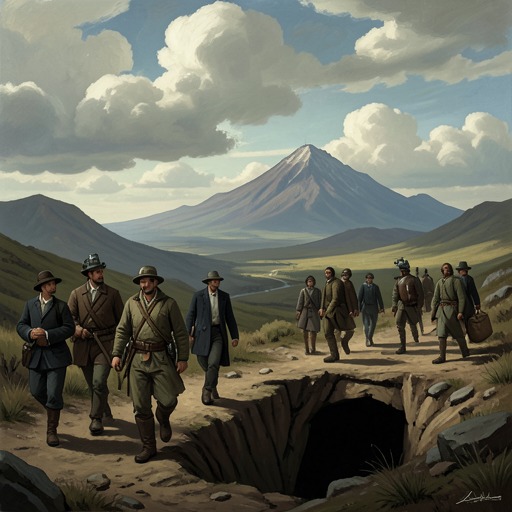
On June 23, Hans waits outside the presbytery with his three companions, all loaded with provisions, tools, and instruments. He has also added a large skin of water to the party’s gourds, enough to assure them water for eight days. That addition is a small but consequential measure of his character: where the professor’s attention is fixed on the proposed investigation, Hans attends to the conditions that will make the journey possible.
The four horses carry the baggage and the two principal travelers, while Hans refuses to mount one and relies instead on his intimate knowledge of the coast. The party’s departure also brings an unexpected expense: the rector and his companion present an exorbitant bill, including a charge for the dirty pastoral house. Professor Hardwigg pays without bargaining. Hans’s own contract, by contrast, has already fixed both his wage and the Saturday-night deadline, distinguishing the guide’s direct terms from the casual exploitation the travelers encounter on the road.
Character and Narrative Role
Hans’s defining quality is an unsentimental practicality expressed through restraint. He does not match Professor Hardwigg’s excitement with argument or theatrical gestures; he listens, gives concise answers, and attends to distance, transport, payment, and water. His composure is not the absence of action. It is a different kind of readiness, grounded in familiarity with the landscape and in precautions made before they are needed.
As the expedition’s guide, Hans joins scientific ambition to the material realities of travel. The professor supplies the urgent purpose, and Henry records the contrast between that urgency and Hans’s calm; Hans supplies knowledge of the route and preparations that protect the party’s ability to continue. The evidence of his role is especially concrete at departure: three companions, provisions and instruments, horses for baggage and travelers, and water calculated for eight days. His quiet competence makes the proposed journey not merely an idea, but a plan equipped to begin.